

Presence, Acuity, and Awareness
The Lens That Tunes Reality to Its Truest Resolution: A manifesto for restoring the absolute fidelity of right now
What if the most powerful force in your life isn't time, effort, or even talent—but the quiet distance reality shifts when you're truly, fiercely present?
The only metric that endures is delta: the tangible change you leave in your wake.
This is your invitation to a sharper way of living rooted in unflinching honesty, absolute focus, deliberate sacrifice, and unbreakable presence. Here, outcomes aren't hoped for. They are engineered.
If you're ready to stop measuring life in hours, stop leaking energy to distractions, and start dancing with chaos until it follows your lead—welcome.
The explorations below unpack these ideas thread by thread.
Good Reads
Philosophy and Life
Fatal Strategies by Jean Baudrillard
Fatal Strategies is a 1983 philosophical work by French thinker Jean Baudrillard. In it, Baudrillard explores the concept of "fatal strategies" — the idea that in a hyperreal world dominated by signs, simulation, and excess, traditional rational or critical approaches lose their effectiveness. Instead, he argues that certain ironic, excessive, or seductive logics (those of the object, the system, or events themselves) often prevail over human intention.
The book examines topics such as the reversal of cause and effect, the ecstasy and obscenity of communication, the role of seduction versus production, and the ways in which contemporary culture and technology operate beyond conventional meaning or control. It builds on ideas from Baudrillard’s earlier writings on simulation and the end of the real, presenting a more radical and provocative stance.
Written in Baudrillard’s characteristic aphoristic style, Fatal Strategies is considered one of his major contributions to postmodern thought and media theory.
Simulacra and Simulation (The Body, In Theory: Histories Of Cultural Materialism) by Jean Baudrillard
This foundational work in postmodern philosophy and cultural theory explores how contemporary society has replaced reality and meaning with symbols and signs, leading to a condition Baudrillard calls “hyperreality.” In his provocative treatise, Baudrillard examines the implications of a world where simulations (copies without originals) precede and shape what we consider real, blurring the boundary between reality and representation. Through analysis of mass media, consumer culture, and technological influence, he argues that modern life is dominated by "simulacra," images and concepts that no longer refer to any authentic reality but instead reference each other, creating an endless cycle of signification detached from truth. With references ranging from Disneyland to the news media, this book offers a challenging critique of how people in the late twentieth century and beyond perceive, construct, and interact with the world, underlining the instability of meaning in a media-saturated culture.
Construction
The Very Efficient Carpenter: Basic Framing for Residential Construction by Larry Haun
The essential, step-by-step guide to framing your own house―updated for the modern builder and savvy DIY homeowner.
Larry Haun, a legendary production framer with over 35 years of experience, distills a lifetime of knowledge into one invaluable course. This book shows you, step-by-step, the efficient, professional techniques used to frame a basic house, from laying down the sills to cutting the rafters.
Strategy
Thinking Strategically: The Competitive Edge in Business, Politics, and Everyday Life by Mark Delgado
A major best seller in Japan, Financial Times top-ten book of the year, Book-of-the-Month Club best seller, and required reading at the best business schools, Thinking Strategically is a crash course in outmaneauvering any rival. This entertaining guide builds on scores of case studies taken from business, sports, the movies, politics, and gambling. It outlines the basics of good strategy-making and then shows how you can apply them in any area of your life.
Chance, Strategy, and Choice: An Introduction to the Mathematics of Games and Elections
Games and Choices is an accessible undergraduate textbook that introduces game theory as a powerful way to understand strategic thinking and everyday decision-making. Aimed at freshmen and sophomores with only high school math as a prerequisite, the book uses familiar examples like gambling games, rock-paper-scissors, and social dilemmas such as the Prisoner’s Dilemma to explore core concepts including Nash equilibria, zero-sum games, and combinatorial games.
It progresses to deeper ideas with clear explanations of results like the Sprague–Grundy Theorem, while gently introducing mathematical proofs and logical reasoning. The text emphasizes how game theory reveals hidden patterns in competition, cooperation, and choice, encouraging a more critical examination of the decisions we face in daily life.
Art
Color by Betty Edwards
This guide distills the enormous existing knowledge about color theory into a practical method of working with color to produce harmonious combinations. Edwards provides a basic understanding of how to see color, how to use it, and-for those involved in art, painting, or design-how to mix and combine hue
Creative Illustration by Andrew Loomis
During his career as one of America's most sought-after illustrators, Andrew Loomis (1889-1959) taught at the American Academy of Art in Chicago, and in 1939 he codified his lessons in his first manual, Fun with a Pencil. Four years later it had already been through six printings, and he followed up over the next two decades with a series of even more successful how-to books that remain the gold standard for artists to this day.
Creative Illustration is considered Loomis's magnum opus, which was aimed primarily at the professional-level illustrator. Divided into seven sections: Line, Tone, Color, Telling the Story, Creating Ideas, Fields of Illustration, and Experimenting and Studies, this book is filled with instructions, tips, insider experiences, and incredible illustrations.

Ebb, Flow, and Manifestation
Insight arrives in moments of heightened attention, then recedes as it integrates. What feels like loss is often the work taking hold.

Effort After Automation
When meaning is decoupled from output, what continues to be human?

Absolute Focus
Focus is the variable that scales every other input: acceleration emerges as a property of coherence, not intensity

Extreme Honesty
Extreme honesty restores fidelity between perception and reality, separating signal from static through disciplined awareness. It removes distortion rather than inventing clarity, aligning emotion, intuition, and evidence until truth stands constant and unbroken.

The Architecture of the Leap
Explore how deliberate contact with uncertainty constructs a future shaped by intent, and how the leap becomes the encounter that crystallizes faith into understanding

How to Engineer an Inevitability
How to build so much stored leverage that when you act, the result isn’t left to chance. Preparation, timing, and precision combine to create outcomes that can’t be undone.

Flow, Proximity, and Positioning
A quiet look at how value moves — the channels it follows, where it accelerates, and how your position shapes what reaches you.

Collapsing Unwanted Futures
Collapsing the futures we don’t want isn’t about loss — it’s about clarity. Every decision narrows possibility, silences paths we’ll never walk, and makes room for the one we choose to become.

Continuity, Awareness and Presence
Time, money, and identity shape nearly every decision we make — but none of them are fixed realities. Weeks and weekends, value and status, labels and roles: they’re frameworks we invented to organize life, not truths written into it. This essay examines how these constructs define our choices, limit our freedom, and distort our awareness — and what it means to return to the present moment beneath them.

How Habits Shape Identity
Explore how unconscious patterns control outcomes and how noticing them creates space for deliberate choice.
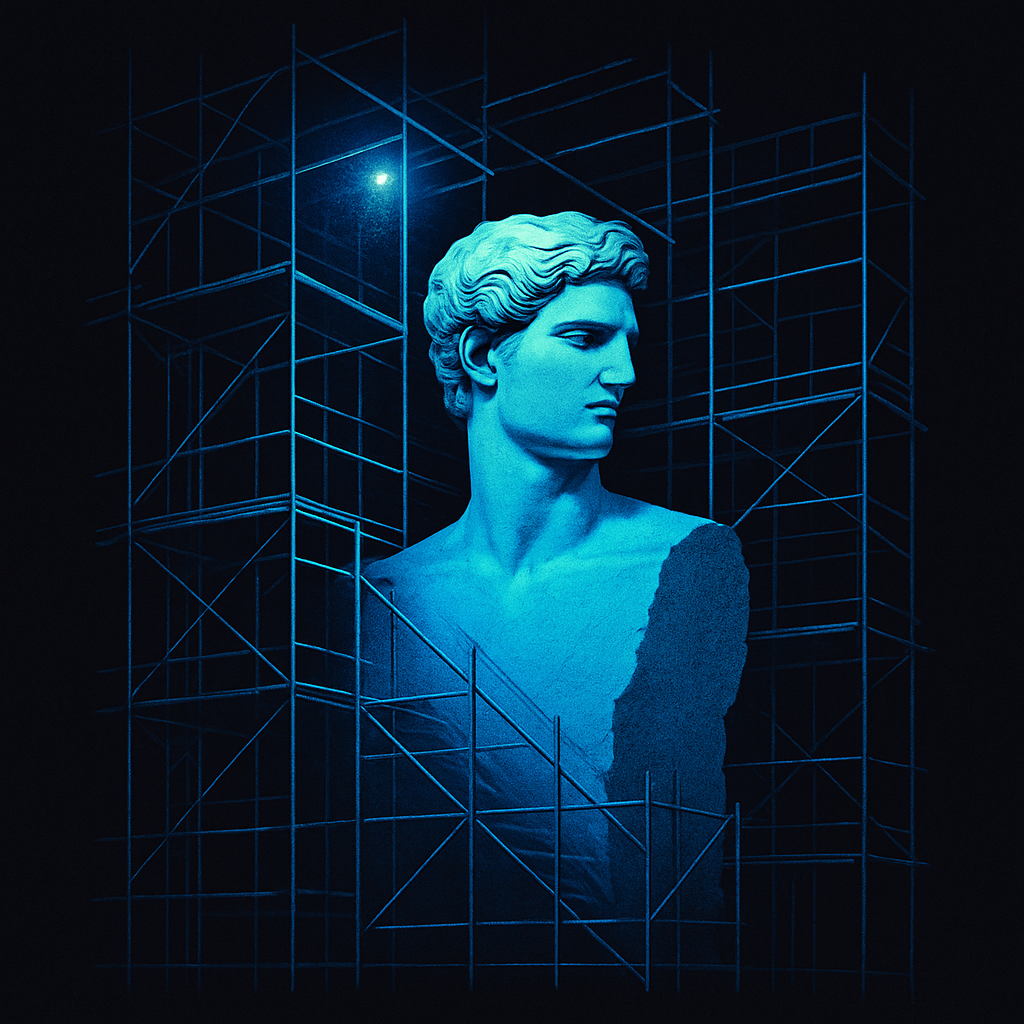
How Pressure Catalyzes Creativity
When the stakes are real, creativity behaves differently. Pressure collapses options into clarity, forcing ideas to surface that couldn’t exist under comfort. These aren’t abstract visions — they’re precise, situational sparks born from urgency and consequence.

Feedback and Choice
What do we do when reality disagrees with us? A look at decisions, frameworks, and the quiet role feedback plays in shaping wisdom.

The Shape of Sacrifice
Sacrifice reshapes us. In surrendering comfort, control, and certainty, we create the capacity to build something greater than ourselves.

How Action Creates Clarity
Discover why clarity follows action and how massive execution resolves uncertainty faster than planning.